Teaching Artefact One: Reflective Journal Entry
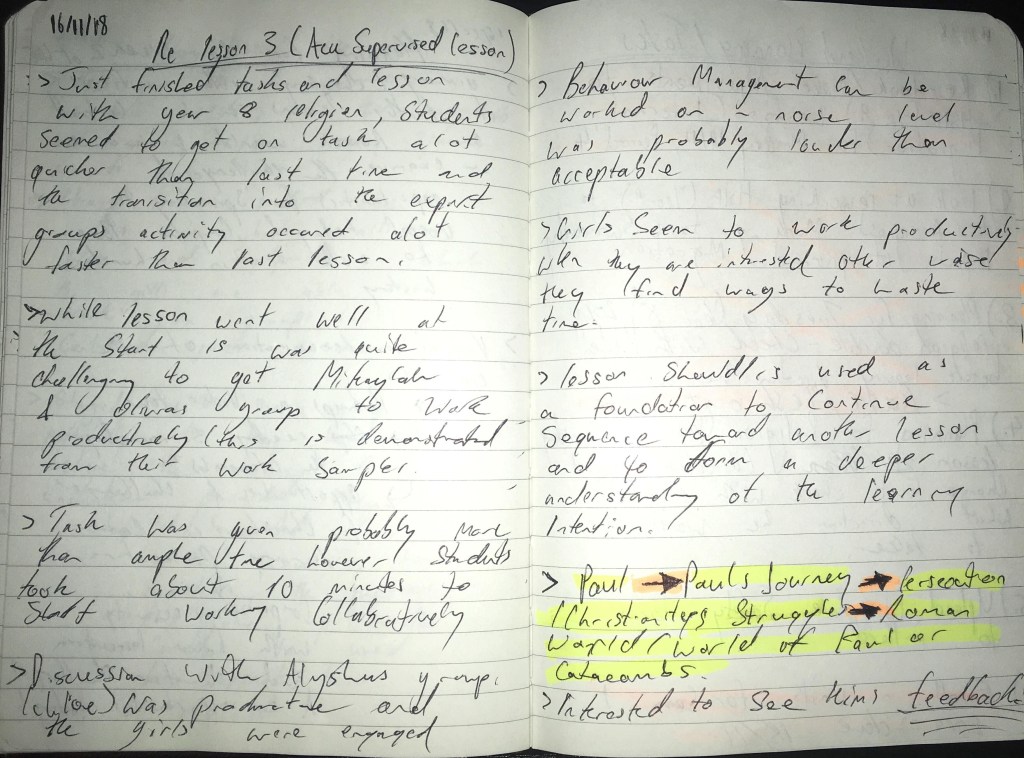
The following artefact demonstrates my engagement with standard 6 (Engage in professional learning) of the APST’s. The artefact specifically reflects 6.2 and 6.3 which require engagement with colleagues and professional learning in order to improve teaching practice (AITSL, 2017). The artefact is taken from my own reflective journal during my second teaching placement. The reflective journal was a record of my observations, lesson ideas, planning and reflections both of my own teaching and of the advice received from various colleagues during my placement. The artefact details a reflection of a Year 8 religion lesson which was supervised by my tertiary supervisor. Seen in the Artefact are my own opinions and reflections on areas that need to be improved as well as notes on students who require additional support or adaptation in their learning. Scott, Alter and McQuillan (2010) suggest that reflection on teaching allows for the gathering of information needed to make appropriate adjustments and determine an appropriate response to the teaching situation. The attached artefact reflects the ideas presented as seen in the second page of the journal which illustrates my own reflection on what adjustments can be made toward future lessons.
Further conversations outside of my reflective journal with my supervising teacher and other colleagues allowed for further development of proposed strategies and approaches to improving my practice.
In reflecting personally and seeking the support of experienced teachers, I not only benefited my own professional practice but my students learning through identifying flaws in my own teaching and seeking support in both reflective practice and through mentor teachers.
Words: 260
Teaching Artefact Two: Google Classroom Differentiated Lesson Plan
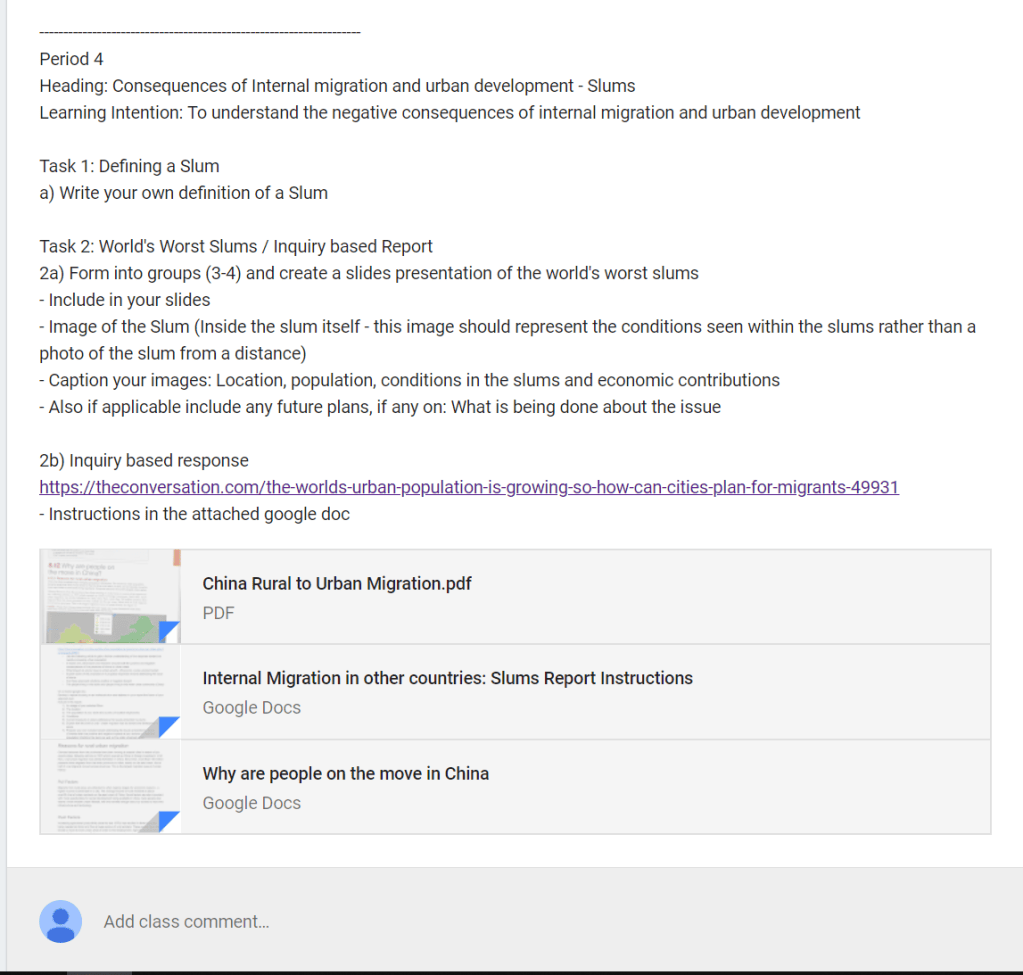
This artefact addresses the professional knowledge category of the APST’s, specifically standard 1.5 and 2.6 which focus on differentiation across the full range of abilities and implementing ICT into the classroom (AITSL, 2017). The artefact is a differentiated lesson posted to google classroom while on my second teaching practicum.
The school I was placed at emphasised the use of ICT and google classroom in all areas of learning, in posting instructions and tasks to google classroom students were individually able to access the lesson, resources and task instructions all at their own individual pace. This artefact illustrates the effective integration of ICT in expanding learning opportunities for students, as a digital platform allowed for the students learning objectives and goals to be clearly expressed and supported in an engaging digital mode. Ely’s (1999) eight conditions of change support the use of ICT in the classroom arguing that if conditions such as participation, commitment, incentives among others are met ICT can be used effectively and holds benefit in an educational setting.
The artefact also illustrates differentiated practice in my teaching. The class attached to this lesson plan had multiple gifted students that required differentiated work in order to suit their learning needs. The lesson shows an adjusted inquiry-based task. In using google classroom only the selected students were able to see this task providing the gifted students with an extended task without singling out their additional support to their peers (Woolfolk & Margetts, 2013). Modifications could be made to allow other students to access the extended task however the differentiated task suited the needs for the lesson thus providing an effective and useful task that can be used in my future practice.
Words: 281
Teaching Artefact Three: Student Work Sample / Marking Feedback
The following artefact illustrates my understanding of the professional practice component of the APST’s, specifically standards 4.1 and 5.2 regarding support of student engagement and providing feedback of learning (AITSL, 2017).
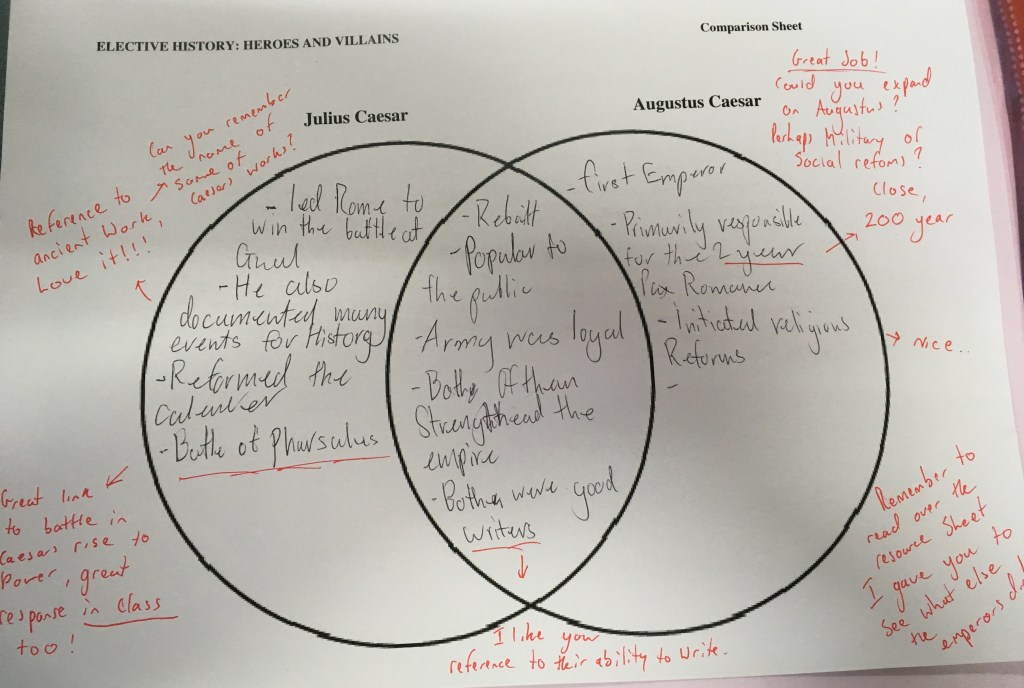
The artefact is both my own teacher developed resource as well as a student work sample which has been marked for student feedback. The resource was given to a year 9 elective history class that was predominately made up of students who struggled with essay writing. In order to support this challenge, I designed the resource in order to keep students who struggled forming arguments into paragraphs engaged yet still able to contribute and access the content through a Venn diagram format. Students were able to work in groups to complete the worksheet, Vygotsky’s (1979) social constructivist approach supports the use of this activity as the students were provided with an opportunity to collaboratively work on a task and were supported in attempting the task through the developed resource.
The artefact also illustrates my ability to provide timely feedback to students. The Venn diagram task was collected at the end of the lesson and marked in order to give students some feedback to reflect how their learning was progressing. Cuttance and Stokes (2000) justify this practice stating “students benefit most when immediate feedback is provided by both teacher and parent”. The feedback was given to students the following lesson and further addresses standard 5.2 directly by providing feedback to students learning. While not a formal task this artefact is effective in demonstrating the importance of giving students informal feedback and is a prominent strategy within my professional practice.
Words: 267

